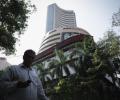
Indian benchmark indices, Sensex and Nifty, closed almost flat in choppy trade as investors remained cautious due to ongoing uncertainty in West Asia, relentless foreign fund outflows, and anticipation of the RBI's monetary policy decision.

Major bills, including those on women's reservation, delimitation, and the Foreign Contribution (Regulation) Act (FCRA), face an uncertain future in the ongoing Monsoon session of Parliament due to persistent opposition protests and a lack of consensus.

For India, the goal is not simply to host another grand diplomatic gathering. It is to prove that a diverse coalition of emerging powers can still deliver.
Among Sensex shares, Tech Mahindra fell by over 6 per cent after the company reported a 60 per cent decline in net profit to Rs 510.4 crore in the December quarter. Bharti Airtel, ITC, HCL Technologies, Asian Paints, Wipro, HDFC Bank, Nestle, Tata Steel, Tata Consultancy Services and Maruti were among the other major laggards. NTPC, ICICI Bank, IndusInd Bank, Reliance Industries, JSW Steel, Bajaj Finance, Bajaj Finserv and Mahindra & Mahindra were among the gainers.

Indian equity benchmark indices Sensex and Nifty experienced a significant tumble in early trade, with the Sensex tanking nearly 700 points, driven by uncertainty surrounding US-Iran negotiations, a fresh spike in crude oil prices, and persistent foreign fund outflows.

'Every period of excessive optimism eventually gives way to a correction, while periods of extreme pessimism often create the best investment opportunities.'

Finance Minister Nirmala Sitharaman stated that India is likely to sustain economic growth of 7 per cent or more in 2026-27, continuing the pace recorded since the Covid-19 pandemic, despite geopolitical uncertainties and supply-chain disruptions.

The rules require nuclear plant operators to maintain an insurance policy, financial security or a combination of both to cover civil liability for nuclear damage.

Indian startup funding plummeted by 43 per cent year-on-year to $7.81 billion between March 1 and June 15, 2026, largely due to the West Asia conflict, which has amplified global risk perceptions, tightened liquidity, and led to rupee depreciation, making global investors cautious.
Indian benchmark indices, Sensex and Nifty, experienced a significant drop of over 1 per cent, driven by a bearish trend in global markets, weakness in HDFC Bank and IT firms, and fresh foreign fund outflows.
From the Sensex basket, PowerGrid, Bharti Airtel, Wipro, HDFC Bank, Kotak Mahindra Bank, UltraTech Cement, Asian Paints, Infosys and Reliance Industries were the major laggards. Bajaj Finance, NTPC, Larsen & Toubro, Axis Bank, Tata Motors, IndusInd Bank and Bajaj Finserv were among the gainers.

Indian stock markets, including the Sensex and Nifty, rebounded significantly, driven by a decline in crude oil prices and positive global cues stemming from hopes of diplomatic progress in US-Iran negotiations.

Inflows into non-resident Indian (NRI) deposit schemes decreased by 23.24 per cent to $2.78 billion during the first quarter of FY27, down from $3.61 billion in the previous year, according to Reserve Bank of India (RBI) data.

Economists widely anticipate the Reserve Bank of India's Monetary Policy Committee will increase the repo rate by 50 basis points, likely split between the October and December meetings, as retail inflation is projected to peak at 6.1 per cent in the third quarter, exceeding the RBI's tolerance limit.

August 2026 witnessed a significant surge in India's primary market, with 21 mainboard initial public offerings (IPOs) raising approximately 21,000 crore, marking the highest monthly deal count of the year, even as benchmark indices experienced declines.

Net inflows into smallcap funds surged 39 per cent M-o-M to a record Rs 7,768 crore, while midcap fund inflows rose marginally to Rs 6,192 crore.

Newly listed companies Vedanta Aluminium Metal, SBI Funds Management and Manipal Health Enterprises have entered the Rs 1 trillion mcap list since March 2026.

Higher US Treasury yields, particularly the 10-year yield approaching 5 per cent, pose a significant near-term risk to global equity markets, including India, potentially triggering a 'big correction' according to market strategists.

Former Chief Economic Adviser Krishnamurthy V Subramanian outlines India's strategy to become a USD 55 trillion economy by 2047. The plan hinges on leveraging its young demographic in AI, dominating sunrise sectors like space and defence tech, attracting FDI, and achieving sustained 8% GDP growth.

Among the 30 Sensex firms, HCL Technologies, NTPC, Bajaj Finserv, Tech Mahindra, JSW Steel, Titan, Mahindra & Mahindra, Tata Steel, Larsen & Toubro and Tata Consultancy Services were the biggest gainers. Kotak Mahindra Bank, IndusInd Bank, Maruti and Hindustan Unilever were among the laggards.

State-run ONGC plans a massive Rs 1 trillion investment in deepwater exploration over the next five years, aiming to drill 87 wells to counter declining domestic crude oil and natural gas production. The company is also establishing a trading firm and its overseas arm, OVL, is pursuing operatorship of assets in Venezuela.

Nepal is grappling with a deepening flood crisis as the death toll from devastating flash floods in Rasuwa and surrounding districts has tragically risen to 538, with authorities now warning of a fresh flood threat and initiating evacuations.

'Value is not where you make money in India. It never has been.' 'You have to buy momentum.' 'Momentum is in technology, and I don't see that slowing down because I believe the AI infrastructure boom is going to last for a while.'

'Ultimately, banks are a channel for people to get some long-term return, and this means banks need to adjust their asset-liability mismatch.' 'Customers also need long-term deposits, say those of three-five years. How would they get them if returns on those deposits do not climb?' 'Otherwise, on fixed deposits, a senior citizen doesn't get anything.'

The US Department of Homeland Security has proposed an additional fee of USD 103,265 for all H-1B visa cap-subject applications, including those eligible for the advanced degree exemption. This new fee aims to recover interagency costs for immigration programmes and would be paid in addition to existing fees. The proposal is open for public comments for 30 days and has drawn criticism from immigration advocates.
Indian benchmark indices Sensex and Nifty rallied in early trade, driven by a positive trend in global markets, cooling crude oil prices following a US-Iran peace deal, and fresh foreign fund inflows.

Nepal's devastating flash floods have claimed 1,127 lives, with thousands still missing a week after the disaster. Rescuers are intensifying efforts to find survivors and recover bodies across affected regions, while police work to identify victims and relocate families from high-risk areas.
Among the Sensex firms, Hindustan Unilever, Tech Mahindra, Infosys, Reliance Industries, Bajaj Finance, Tata Consultancy Services, Titan and UltraTech Cement were the major laggards. Mahindra & Mahindra, Power Grid, IndusInd Bank, Tata Motors, Larsen & Toubro and Maruti were among the gainers.

Among the Sensex firms, Asian Paints, Titan, Larsen & Toubro, JSW Steel, ITC, Hindustan Unilever, Maruti and Reliance Industries were the major gainers. ICICI Bank, NTPC, Infosys, Tech Mahindra, Tata Steel and Bajaj Finance were among the laggards.

RBI Governor Sanjay Malhotra announced plans to launch long-lasting polymer currency notes by the next financial year. He also discussed the central bank's data-dependent approach to interest rates, its focus on aligning inflation with the 4 per cent target, and the orderly trajectory of the rupee amidst geopolitical tensions.

The Central Information Commission has said the blanket denial of information sought on Foreign Contribution (Regulation) Act renewal applications by the Union ministry of home affairs "appears to be misplaced and without any basis", while observing that the CPIO prima facie "obstructed" the complainant's right to information.

'Once you're wrestling with making a merger of that scale value-accretive, you're also under pressure to keep growing the balance sheet and chasing liabilities, and other things start to slip as a consequence.'

DIIs invested $22.8 billion in Indian equities in Q2CY26.


There is no answer to the question of how IN-SPACe invited EOIs for ISRO's mature rockets and whether it was based on any government policy decision.
From the Sensex pack, Larsen & Toubro jumped over 3 per cent.ITC, Reliance Industries, Sun Pharma, Kotak Mahindra Bank, Axis Bank, Infosys and State Bank of India were the other major gainers.
Indian stock market benchmark indices, Sensex and Nifty, experienced declines in early trade due to escalating tensions between the US and Iran, which led to a surge in crude oil prices and weak global equity trends.

Donald Trump has strongly refuted claims of a munitions shortage and denied any confrontation with Defence Secretary Pete Hegseth, labelling the reports as "fake news" and asserting the nation's robust military production capabilities.
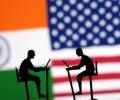
A think tank, GTRI, has urged India to resist US pressure regarding its UPI policies, advocating for the defence of competition, policy autonomy, and the long-term sustainability of its payments ecosystem. This comes as the Lok Sabha passed a bill allowing charges on UPI transactions, a move GTRI suggests should not be influenced by foreign trade complaints.

Sarvam AI, an Indian full-stack sovereign artificial intelligence company, has achieved unicorn status after raising $234 million in a Series B funding round led by HCLTech and Bessemer Venture Partners, with HCLTech acquiring a 10.46 per cent stake.
